Management
Dental Practice KPIs: The Metrics Every Owner Should Track
A practical guide to the dental practice KPIs that reveal profitability, costs, margins, productivity, pricing, and financial health.

Most dental practices track production, collections, and appointment volume. Those numbers are useful, but they do not always reveal whether the business is truly profitable.
The right dental practice KPIs help owners understand what is happening beneath the surface: which procedures generate strong margins, how much treatments really cost, whether chair time is being used efficiently, and whether pricing decisions are financially sustainable.
A strong KPI system should not simply report activity. It should help the practice make better decisions.
What Are Dental Practice KPIs?
Dental practice KPIs are measurable indicators that help owners understand how the business is performing. They can measure clinical activity, financial performance, productivity, patient acquisition, and operational efficiency.
The most useful KPIs are not just numbers on a report. They are signals that help answer important business questions.
Is the practice profitable? Are fees high enough? Which procedures generate the strongest margins? Is overhead under control? Is growth actually improving financial health?
Why Revenue Alone Is Not Enough
Revenue is one of the most commonly tracked metrics in dentistry. But revenue only shows how much money comes into the practice.
It does not show:
- Whether procedures are profitable
- Whether fees are financially sustainable
- Which treatments consume too many resources
- How overhead affects margins
- Which providers generate the strongest returns
- Whether growth is actually improving profit
A practice can increase production and still struggle financially if costs, overhead, pricing, or productivity are not being measured correctly.
The Essential KPIs Every Dental Practice Owner Should Track
Every practice is different, but certain KPIs are especially important for understanding financial health.
- Revenue
- Net profit margin
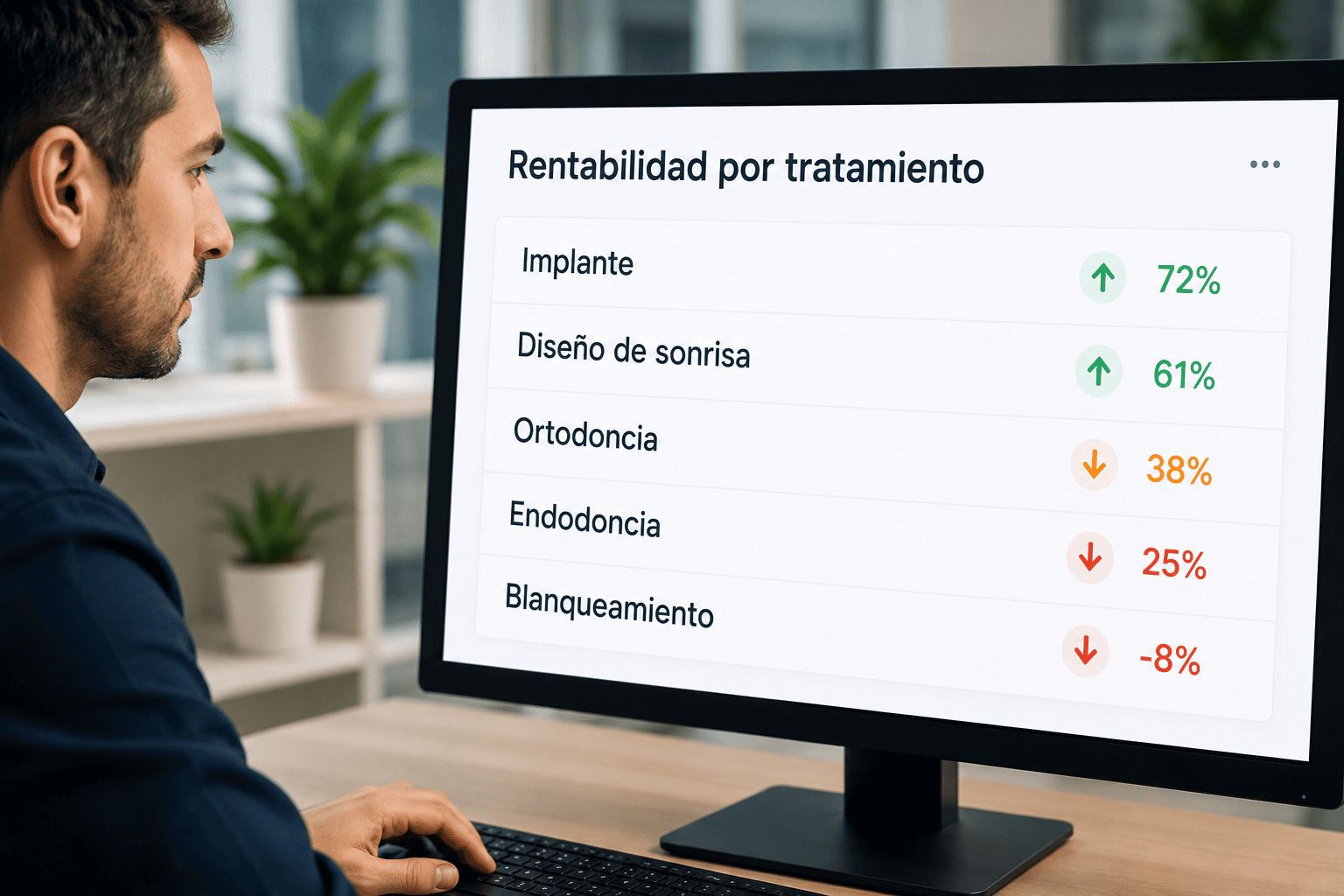
- Profitability by procedure
- Cost per procedure
- Cost per clinical hour
- Overhead percentage
- Revenue per provider
- Schedule utilization
- Patient acquisition cost
Together, these KPIs help owners understand whether the practice is growing profitably or simply becoming busier.
Profitability KPIs
Profitability KPIs show whether the practice keeps enough money after covering the costs required to deliver care and operate the business.
Important profitability KPIs include:
- Net profit margin
- Gross profit margin
- Profit margin by treatment
- Profit per clinical hour
- Profitability by provider
- Low-margin procedures
These metrics are essential because they reveal whether revenue is turning into sustainable profit.
Cost KPIs
Cost KPIs help owners understand what it really takes to deliver each treatment. Without these metrics, pricing decisions often rely on assumptions.
Useful cost KPIs include:
- Clinical material costs
- Laboratory expenses
- Specialist compensation
- Staff costs
- Overhead allocation
- Patient acquisition cost
- True cost per procedure
When cost KPIs are missing, procedures usually appear more profitable than they really are.
Productivity KPIs
A dental practice has limited clinical capacity. That means the value generated per hour matters as much as the total revenue generated.
Productivity KPIs include:
- Schedule utilization
- Chair time by treatment
- Revenue per clinical hour
- Profit per clinical hour
- Provider productivity
- Unproductive clinical time
These KPIs help identify whether clinical time is being used by high-value treatments or consumed by low-performing procedures.
Pricing KPIs
Pricing is one of the most important areas where KPIs can improve financial performance. Fees should not be based only on competitors, intuition, or outdated schedules.
Pricing KPIs may include:
- Minimum profitable fee
- Current fee vs. true cost
- Target margin
- Recommended fee
- Procedures affected by rising costs
- Pricing scenario comparison
These insights help owners understand whether current fees are enough to cover costs and support healthy margins.
Warning Signs Your KPIs Are Missing Something Important
If a practice tracks only surface-level activity, financial problems can remain hidden for months or years.
Warning signs include:
- Revenue increases but profit does not
- Production grows while cash flow stays weak
- Procedure margins are unknown
- Overhead increases faster than revenue
- Chair time is consumed by low-margin treatments
- Pricing decisions rely on assumptions
These signs usually indicate that the practice needs better visibility into costs, margins, overhead, and procedure-level profitability.
Common KPI Mistakes in Dental Practices
Many practices collect data, but not all data improves decision-making. The wrong KPI system can create noise without clarity.
Common mistakes include:
- Tracking too many vanity metrics
- Looking only at production
- Ignoring treatment-level profitability
- Using outdated cost assumptions
- Not measuring chair time
- Not connecting KPIs to decisions
The goal is not to track every possible metric. The goal is to track the numbers that help the practice make better financial decisions.
How Klynic Helps Dental Practices Track the KPIs That Matter
Klynic was built to help dental practices move beyond production reports and understand the financial metrics that actually drive profitability.
With Klynic, you can:
- Calculate true treatment costs
- Measure profitability by procedure
- Understand cost per clinical hour
- Analyze overhead impact
- Identify low-margin treatments
- Compare pricing scenarios
- Make financial decisions with reliable data
Klynic helps owners understand which treatments create value, which procedures need attention, and how pricing and margins affect the financial health of the practice.
Final Thoughts
Dental practice KPIs are only useful if they help owners make better decisions. Production and collections are important, but they are not enough.
The most valuable KPIs reveal true treatment costs, profit margins, overhead impact, clinical productivity, pricing health, and procedure-level performance.
When those numbers are visible, dental practices can protect margins, improve profitability, and grow more sustainably.
How Klynic helps dental practices track the KPIs that matter
Klynic helps dental practices calculate true costs, measure margins, understand clinical hour value, analyze overhead, compare pricing scenarios, and identify underperforming treatments.
- True treatment costs
- Profitability by procedure
- Cost per clinical hour
- Pricing and margin visibility